
Climbing From 100 TH/s: What Each Step Toward 1 PH/s Buys
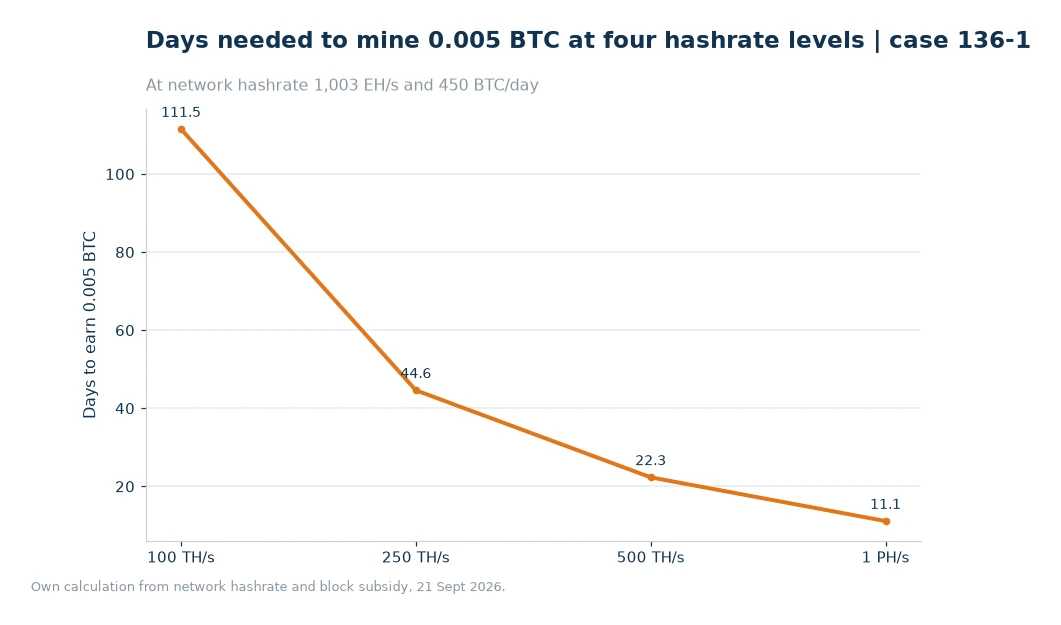
Upgrades are usually discussed as a single leap, but the ladder from one small machine to a petahash is made of rungs, and each rung saves less time than the one below it. Starting at 100 TH/s, a 0.005 BTC target takes 111.5 days; at 250 TH/s it takes 44.6; at 500 TH/s it takes 22.3; at 1 PH/s it takes 11.1. The first step removes 66.9 days and the last removes 11.2, for far more hardware.

Key takeaways
- Each doubling of hashrate halves the days to 0.005 BTC, from 111.5 at 100 TH/s to 11.1 at 1 PH/s.
- The first upgrade, 100 to 250 TH/s, removes 66.9 days; the last, 500 TH/s to 1 PH/s, removes 11.2.
- Days saved per terahash added falls from 0.446 to 0.022 as the ladder climbs.
- Pool Hashrate and Pool Luck describe the pool, so they should not be used to justify a hardware step.
Every doubling buys the same halving
The relationship is simple enough to hold in your head: double the hashrate and the time to any fixed BTC target halves. That is true at every rung, and it is the reason upgrades feel satisfying at the bottom and expensive at the top. The percentage improvement is constant while the absolute number of days removed shrinks.
The fixed target is what makes the comparison honest. If the goal moves as the hashrate grows, no ladder can be evaluated. Pick the amount first, hold it, and measure each step against the same endpoint. A hobbyist who keeps raising the target as income rises is not climbing a ladder at all; they are walking on a treadmill and calling it progress.
Why the first step feels larger than the last
Going from 100 to 250 TH/s cuts a 111.5-day wait to 44.6 days. That is a change a person can feel: a target that spanned a season now fits inside six weeks. Going from 500 TH/s to 1 PH/s cuts 22.3 days to 11.1, which is a smaller absolute gain even though the added hashrate is twice as large. The hardware bill for the second step is also larger.
This is not an argument against the top of the ladder. A machine at 1 PH/s produces five times the coins of one at 100 TH/s every day, and over a long horizon the daily rate compounds. It is an argument against expecting each upgrade to deliver the same improvement in waiting time. Buyers who expect that tend to overpay for the last rung and then feel disappointed by it.
Pool Hashrate, Pool Luck and a rig that grows
An upgrade does not change the pool's behavior, and the pool's behavior should not change the upgrade decision. Pool Hashrate is the pool's share of the network; Pool Luck is how its recent finds compare with expectation for that share. Both are worth watching when comparing pools, and neither tells you whether a second machine is a good purchase.
The ViaBTC BTC Mining Pool page reports Pool Hashrate and Pool Luck for the pool you are on, and it is the right reference when you want to know what the pool looks like from outside. Note the two figures before an upgrade and again after; they should be unchanged, which is a useful confirmation that the step was a hardware change rather than a change of venue.
What an upgrade does change is your own share of the pool and of the network. Under PPS+, the credit is proportional to shares submitted, so doubling hashrate doubles the hourly credit without altering the settlement mechanics. Under PPLNS, the same doubling also doubles your weight in the last five difficulty rounds, which shifts your slice of each block. The scheme stays fixed; only the size of your position moves.
Where the ladder analogy breaks
A ladder implies that every rung is available to anyone willing to climb. In a home setup that stops being true fairly quickly. The circuit feeding the rig has a limit, the room has a heat load it can reject, and the noise has a threshold beyond which neighbors become a factor. Those are step changes rather than gradual costs: a second machine may fit the wallet and not the breaker.
When that happens the upgrade stops being a hardware purchase and becomes a facilities project. New circuits, extra ventilation, acoustic treatment or a move to hosted space all cost money that does not appear in a hashrate comparison. The ladder still describes the arithmetic, but the price of the next rung is set by the building rather than by the miner, and that is usually the point at which the climb pauses, not because the hashrate stopped helping but because helping stopped being the only question worth asking about the next rung.
Four rungs on the ladder
The table adds a column for days saved against the rung below, which is the number that makes diminishing returns visible.
| Step | Machine | Days to 0.005 BTC | Improvement over prior step |
|---|---|---|---|
| 1 | 100 TH/s | 111.5 | — |
| 2 | 250 TH/s | 44.6 | 66.9 |
| 3 | 500 TH/s | 22.3 | 22.3 |
| 4 | 1 PH/s | 11.1 | 11.2 |
Worked example
Convert the ladder into days saved per terahash added, which is the fairest way to compare steps of different sizes.
- Per terahash: 450 ÷ 1,003,000,000 = 0.00000044865 BTC daily, the 4.5e-07 figure used throughout.
- At 100 TH/s: 0.00004487 a day, which is 4.486e-05, so 0.005 ÷ 0.00004487 = 111.5 days.
- Step one adds 150 TH/s and saves 111.5 − 44.6 = 66.9 days: 66.9 ÷ 150 = 0.446 days saved per TH/s.
- Step two adds 250 TH/s and saves 44.6 − 22.3 = 22.3 days: 22.3 ÷ 250 = 0.089 days saved per TH/s.
- Step three adds 500 TH/s and saves 22.3 − 11.1 = 11.2 days: 11.2 ÷ 500 = 0.022 days saved per TH/s.
- The efficiency of an upgrade, measured this way, falls by a factor of five at each rung.
Put beside a hardware quote, that column changes the conversation. A small addition to a small rig is cheap in days-per-terahash terms and often the best value on the ladder. A large addition at the top is expensive in the same units but produces the highest absolute daily income, which matters if the coins are being accumulated rather than spent. Both readings are correct; they answer different questions.
Frequently asked questions
Does doubling hashrate always halve the time to a target?
Yes, at constant difficulty and continuous uptime, because time equals target divided by daily output and daily output is proportional to hashrate; a 0.005 BTC target falls from 111.5 days at 100 TH/s to 11.1 at 1 PH/s.
Which rung gives the best return in days saved?
The first, at 0.446 days saved per terahash added between 100 and 250 TH/s, against 0.089 on the next step and 0.022 between 500 TH/s and 1 PH/s.
Should Pool Luck influence when I upgrade?
No. Under PPS+ the hourly credit follows difficulty rather than pool luck, so a lucky or unlucky stretch says nothing about whether the next machine will pay for itself.
Write the rung down before you buy it
For each candidate step, record the added hashrate, the days it removes from the target and the change in daily coin output. Then compare those three numbers with the invoice, the extra watts and the space the machine needs. The Mining Farms option is worth pricing if a second machine would overload the home supply, and the Profit Calculator will show the daily figure at the new hashrate before the hardware is ordered.
Sources: ViaBTC farms, calculator, pool-state and pricing pages for Pool Hashrate, Pool Luck and the fee schedule; the listed 4% sits on the block-reward component[1]. Values read 21 September 2026: 1,003 EH/s network, 3.125 BTC each block, 144 blocks daily, BTC $84,692. Published 24 October 2026; ladder figures assume steady difficulty and continuous running.